
Insights
How to Turn One Skincare Product Into a Week of Posts
Plan three useful posts around one skincare product, with a shot list, caption starters and a check of the page shoppers will land on.
Youanai Editorial
6 min read
Plan three useful posts around one skincare product, with a shot list, caption starters and a check of the page shoppers will land on.
The product photos are ready. The posts aren't. Another picture of the same jar still needs a reason for someone to stop and look.
Choose one product and answer a different shopper question in each post: what it looks like, how to use it, or what arrives in the order. Reuse the photos and footage where they fit. Then check that the linked product page gives the same answer.
The plan below uses three posts as a manageable starting point, not a claim about the ideal posting frequency. If you can make only two useful posts, make two. Leave time to answer the replies.
Start with a product fact card
Choose a product you can sell now and show accurately. A launch that still needs packaging approval is a poor candidate for a quick content batch.
Before writing captions, put these details in one note:
- Product name and current product-page link.
- What the customer receives: format, size, packaging, and included items.
- Directions from your approved label or product information.
- Claims you can support, with the source for each one.
- Current price, availability, and any offer terms you plan to mention.
- Three actual questions from customer messages, reviews, or conversations. Remove personal details.
No customer questions yet? Write down likely questions and mark them as assumptions. Ask shoppers which matter. Do not present an invented question as a customer quote.
Keep the card beside you while drafting. An AI tool can help shorten a caption or suggest another opening. It should not supply missing product facts, testimonials, or results.
Give each post one question to answer
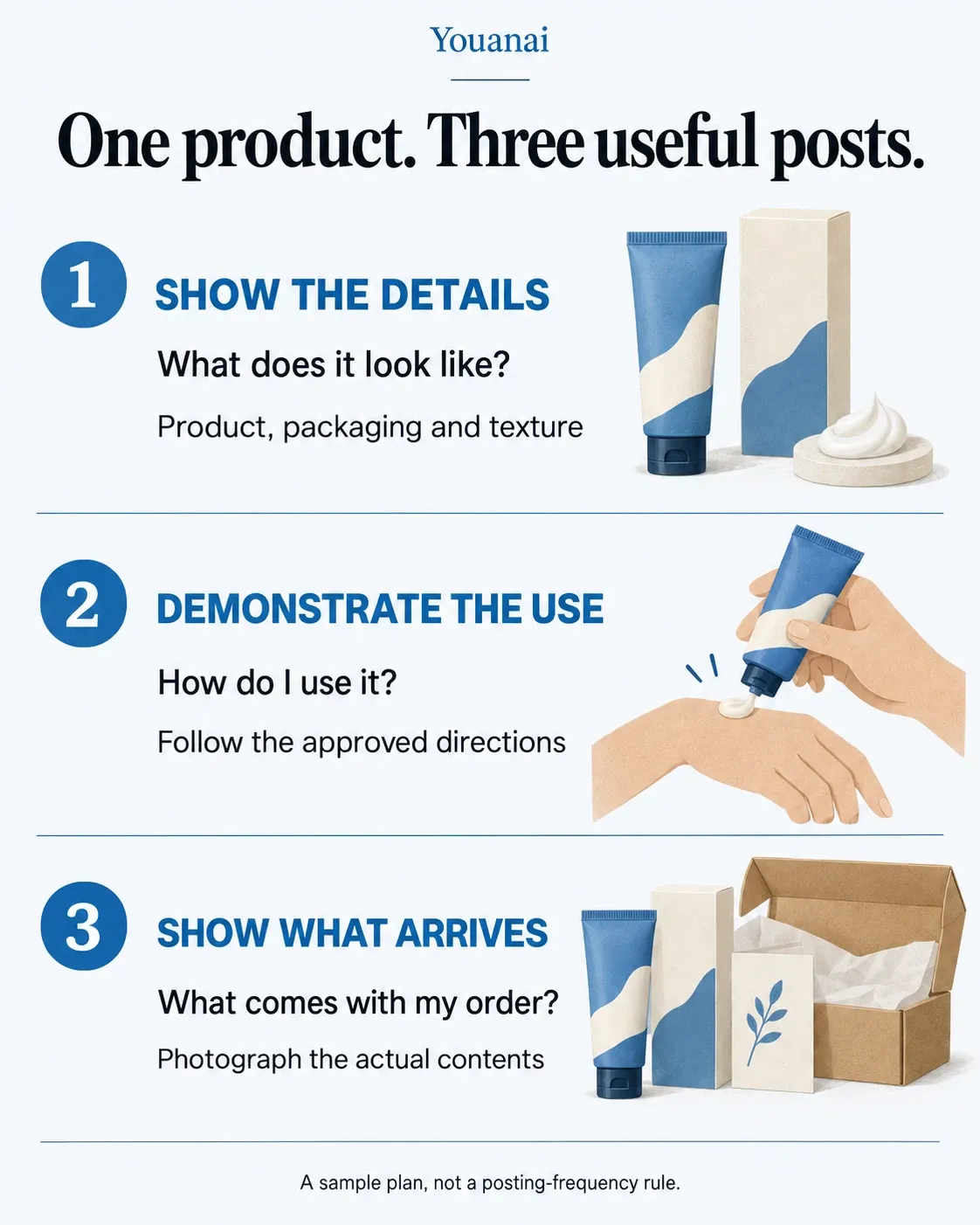
Here is a sample week for a hypothetical hand-cream brand. It is a planning example, not a customer case study. Replace the product and questions with your own.
| When | Shopper's question | Post to make |
|---|---|---|
| Monday | What does it look like outside the pack shot? | A close-up of the real tube and texture |
| Wednesday | How do I use it? | A short demonstration using approved directions |
| Friday | What comes with my order? | An overhead photo or clip of the actual contents |
Move these days to fit your working week. The questions matter more than the weekday labels. Keep optional Stories for an unanswered question or a genuine update; you do not need to fill every gap.
Monday: show the product clearly
Use a photo of the tube next to its outer packaging, followed by a close-up of the product texture. Let the images answer something a polished pack shot cannot.
Caption starting point:
A closer look at [product]: the tube, the packaging, and the texture. Swipe to see each one. Size and ingredients are on the product page.
Before using that caption, check that all three images exist and the page lists the promised details. If the post is a single image, remove “swipe.”
Avoid using an altered texture image as evidence of how the product looks. A label, shade, or pack size that changes between the post and the shop creates another question for the buyer.
Wednesday: demonstrate one use
Film the product in use according to its own instructions. Add readable captions so the sequence still makes sense without sound.
For the structure, adapt the opening, product message, and closing action described in TikTok's beauty creative guide. That is guidance for advertising creatives, not a promise about organic reach.
For example, open with the question “How do you apply it?” Show the relevant steps. Close by pointing to the full directions on the product page.
Caption starting point:
How to use [product], following the directions on the label. We have shown the steps here; the full instructions are on the product page.
Do not turn a use demonstration into a made-up before-and-after result. Leave out claims you cannot support, even if a caption tool suggests them.
Friday: show what arrives
Lay out what a customer receives with the specific item you are promoting. Show the current packaging, not an old sample or a gift bundle sold separately.
Caption starting point:
Ordering [product]? Here is what is in the pack. Check the product page for the current size, price, and delivery information before you order.
Use a link surface that works for the format, such as a Story link or your profile link. Check the route yourself. A caption that says “see the details” is not helpful if the shopper lands on a general homepage and has to start searching.
Gather the assets in one session
Make a short shot list before setting up the camera:
- The product and its current packaging.
- A close-up that shows a useful detail.
- The steps from the approved directions.
- Everything included in the order.
Use those assets across the week, with a different question and caption for each post. Keep the original files and name them by product and subject so you can find them again.
There is a useful public example of this question-led approach. Shopify's skincare marketing guide describes Hanni collecting questions through Instagram Stories before a product launch, then turning answers into a carousel with factory footage. That is Hanni's example, not evidence of a Youanai result or a guaranteed engagement lift.
The part to borrow is the connection between a real question and something the brand can show. You do not need to copy its wording or production style.
Keep the founder's voice in the review
Before approving the batch, read each caption aloud. Would you say it to someone looking at your product at a market stall? Replace phrases that sound unlike you. Then check the facts again.
In Shopify's interview with Beneath Your Mask founder Dana Jackson, she describes reviewing proposed social copy to keep it in her voice and accurate to the products. Her account is a useful reminder: help with drafting does not remove the need for someone who knows the product to review it.
Ask permission before reusing a customer's words or images. Keep their meaning intact. If you have no usable customer proof, show your process or answer a question instead.
Check the page after the post
Open every destination on your phone before scheduling. Check these four things:
- The linked page matches the product shown.
- The answer promised in the post is easy to find.
- The price, availability, and delivery information agree with the caption.
- A shopper can find a contact route for a question the page does not answer.
If you are considering an assistant for those questions, Website Buddy's overview explains the product. Review it against your store's needs and approved information. For the broader decision, see when an assistant, chatbot, or live chat fits the job.
Keep a small record of what happened
After each post, record its question, format, destination, and any useful replies. Add link clicks or product-page visits where your tools report them. Note whether the link identifies an individual post or only the channel.
Likes and saves can tell you what caught attention. They do not establish that a post caused a sale. A shopper may also return later through another route. Use the evidence you have and leave gaps visible.
For next week's plan, ask: which question brought a useful response, which page needs a clearer answer, and which asset was difficult to make? Keep the useful part and change one weak part. A week with little traffic is not enough to declare a format a winner.
Copy this plan for next week
- Product and page:
- Customer question 1 / asset / caption / destination:
- Customer question 2 / asset / caption / destination:
- Customer question 3 / asset / caption / destination:
- Person checking product facts and captions:
- Posting dates:
- What we will review afterward:
Start by filling the first line. Then choose one question you can answer with an asset you already have.
Want to discuss the plan with us? Book a Youanai demo and bring your product page, a few photos, and the question that keeps slowing you down. Tell us you run a skincare brand so the conversation starts with your work.
Prepared with AI assistance for the Youanai editorial team. Public examples belong to the named brands. The hand-cream plan is hypothetical.